
Last updated: August 11, 2026
- What happened in the 24 hours before it?
- Migraine triggers usually arrive as a stack, not a lone switch.
- Key Facts – Migraine triggers are usually patterns, not single causes .
- – A simple log works better than a perfect spreadsheet.
Quick Answer: For many readers, understanding your migraine triggers — complete guide means tracking about 7 common factors for 2 weeks and looking for repeated patterns, not one perfect culprit. The fastest way to get a handle on migraine triggers is simple: stop hunting for a single magic culprit and start spotting your personal trigger pattern. Migraine triggers usually arrive as a stack, not a lone switch. One short night, a skipped meal, hormone shifts, bright light, alcohol, stress, and dehydration can all pile up into an attack.
Key Facts
– Migraine triggers are usually patterns, not single causes.
– A simple log works better than a perfect spreadsheet.
– Sleep, meals, hydration, stress, hormones, and sensory overload are common trigger categories.
– Trigger avoidance has limits, so the goal is risk reduction, not zero risk.
– A 2-week tracking window is enough to start seeing repeating patterns.
I write about headache and migraine care for readers who are tired of vague advice and want something they can actually use. Heard this before? “I know something set this off, but I can’t tell what.” Then this understanding your migraine triggers — complete guide is for you.
What Migraine Triggers Really Are
Migraine triggers are factors that make an attack more likely in someone who already has a migraine brain. This distinction matters. They are not the same as root causes. Migraine is a neurological condition; a trigger is one of the things that can lower your threshold and bring on symptoms.
And this is where a lot of generic articles go sideways. They list triggers as though every person with migraine reacts the same way. They do not. One person’s major trigger may be nothing for someone else. Some people also notice “triggers” that are really early warning signs. For example, craving sweets, yawning, neck stiffness, or mood changes can happen before the headache phase starts. People sometimes blame the sandwich they ate an hour ago when the real migraine was already underway. That mix-up is common.
The practical goal is not to become a detective for one perfect answer. It is to identify your most reliable patterns so you can reduce attack frequency, spot risky combinations, and make better decisions on high-risk days.
A second thing I want to say plainly: trigger avoidance has limits. You cannot live in a bubble, and you should not build your life around fear. Honestly, the best trigger plan is usually the one that helps without making you anxious, isolated, or nutritionally restricted. Too much caution can boomerang.
For broader patient-facing guidance, I’d start with the American Migraine Foundation and the National Institute of Neurological Disorders and Stroke:
– American Migraine Foundation: https://americanmigrainefoundation.org/resource-library/
– NINDS Migraine information: https://www.ninds.nih.gov/health-information/disorders/migraine
The Most Common Migraine Triggers, and Why They Matter
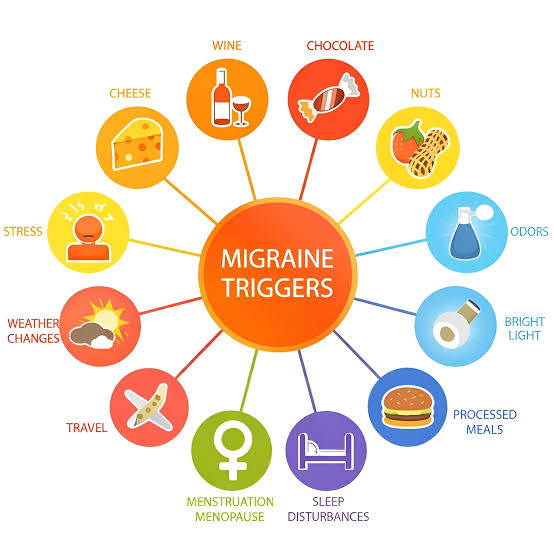
The most useful trigger list is the one that helps you notice patterns, not the one that overwhelms you. To begin, I’d start with the triggers that show up again and again in migraine care: sleep disruption, skipped meals, dehydration, stress letdown, alcohol, hormonal changes, sensory overload, weather shifts, and certain odors.
Sleep changes
Too little sleep can do it. So can too much. The real issue is often inconsistency. A late Friday and a long lie-in on Saturday can be enough to knock some people’s migraine threshold off balance.
Skipped meals and blood sugar swings
Going too long without eating is a classic trigger. So is eating irregularly. This does not mean every migraine is “from low blood sugar,” but the brain tends to dislike missed fuel. I’d watch this especially if your attacks cluster on busy workdays, travel days, or after morning coffee without breakfast.
Dehydration
Mild dehydration can be enough for some people, especially when it combines with heat, exercise, or caffeine changes. The catch? Thirst is not always obvious before the migraine starts for many people.
Stress and stress letdown
Stress is among the most common migraine companions, but here’s the twist: attacks often happen when stress drops, not only when it rises. A deadline, a family crisis, or a tense week can set the stage. Then the migraine arrives on the day off or the first quiet evening.
Alcohol
Alcohol is a common trigger, but it is not universal. Red wine gets a lot of blame, though the real pattern may be the alcohol itself, the sleep disruption that follows, or the missed meal that came before it.
Hormonal changes
For many people, estrogen shifts matter more than single foods do. Menstrual migraine is a major pattern, and attacks may happen predictably around a cycle. This stands as one of the strongest examples of a trigger you may not be able to remove, only plan around.
Sensory overload
Bright light, glare, loud environments, strong smells, flickering screens, and crowded spaces can all push a sensitive nervous system toward migraine. This matters especially if your job or daily routine keeps you in high-stimulation settings. Like sand in a gear, it can wear you down fast.
Weather and barometric pressure changes
Some people notice attacks around storms, heat, humidity, or pressure shifts. The evidence here is less tidy than with sleep or meals, but the pattern is real enough for many sufferers that I wouldn’t brush it off.
Foods
Food triggers exist, but they are usually less universal than the internet suggests. A long list of “forbidden” foods often creates unnecessary restriction. If food seems involved, I would look for repeated patterns, not one-off guesses.
How to Find Your Personal Triggers Without Going Crazy
This is the section I wish more migraine articles spent time on. The real skill is pattern-finding. You are not trying to prove one dramatic cause. You are trying to learn your own threshold.
I recommend a simple, low-friction migraine log. Not a perfect spreadsheet. Not a homework assignment. Just enough to answer a few questions: When did the migraine start? What happened in the 24 hours before it? Did I sleep differently, skip meals, drink alcohol, get dehydrated, have my period, travel, fight, overwork, or spend hours in bright light?
A good log has two virtues: it is specific and sustainable. If it takes twenty minutes a day, you will stop doing it. If it takes one minute, you may keep it going long enough to learn something. That’s the trade-off.
Here is the kind of detail that matters:
– sleep length and quality
– meal timing
– hydration
– caffeine amount and timing
– stress level and major stress changes
– menstrual timing, if relevant
– alcohol
– exercise
– screen time, glare, or bright light exposure
– odors, smoke, or chemical exposure
– weather changes if you suspect them
What I would not do is tear apart every meal for mythical trigger foods. That route often leads to fear-based eating. If you suspect food is involved, use a short, targeted experiment with a clinician’s guidance rather than a permanent long avoidance list.
A useful pattern is this: if the same factor shows up before attacks several times in a row, it deserves attention. If it appears once or twice with no clear pattern, it may just be noise. Many migraine triggers work by stacking, so a minor issue only matters when other factors are already in place.
One honest limitation is that trigger tracking will not always give you a clean answer. This is normal. Migraine can be influenced by multiple variables at once, and some attacks start without any obvious prelude.
The Honest Side-by-Side: What Helps Most, and What Can Backfire
The real choice is not “avoid everything” versus “ignore triggers.” It is between broad, practical trigger management and narrow, over-restrictive trigger hunting. Broad management wins for most people because it lowers attack risk without turning life into a laboratory.
| Criteria | Broad trigger management | Strict trigger hunting | Winner for |
|---|---|---|---|
| Ease of following | Simple habits: regular sleep, meals, hydration, stress planning | Can become complex fast, especially with food rules and constant checking | Busy people who need sustainable changes |
| Risk of over-restriction | Lower, because the focus stays on patterns with broad benefit | Higher, because any suspected food or activity can become “forbidden” | People prone to anxiety around symptoms |
| Best use of effort | Targets high-yield factors like sleep, meals, and hydration | Useful when one very specific trigger keeps repeating | Most migraine patients |
| How fast it can help | Can reduce attack risk over time, though not overnight | May help quickly if a clear trigger is removed | People with one obvious, repeatable trigger |
| Emotional cost | Usually lower; less guilt and fewer “I blew it” days | Can create hypervigilance and blame | People who want less stress, not more |
| Fit for hormonal migraine | Helps with support factors but cannot remove the cycle itself | Often limited, because hormones are not a removable trigger | People with menstrual migraine |
| Fit for lifestyle triggers | Strong, because routine disruptions are often the real problem | Sometimes too narrow to catch stacking effects | Travelers, shift workers, parents of young children |
| Chance of missing the real pattern | Moderate, if the plan is too generic | High, if you focus on one suspected food and miss sleep or stress | People who keep “chasing” the wrong trigger |
My view is straightforward: broad trigger management should be the default. Strict trigger hunting should be reserved for a clearly repeatable pattern, and even then only for a limited, thoughtful trial. The downside of broad management is that it can feel less dramatic. The upside is that it usually helps more than obsessing over one item on your plate.
The Real Difference Between Trigger Avoidance and Trigger Tolerance
The real difference is not how hard you try. It is how much room your nervous system has before it tips into migraine. Some people have a wide buffer. Others have a narrow one. Trigger tolerance changes with sleep debt, stress, hormones, illness, travel, and even medication overuse.
This is why the same trigger can matter one week and not the next. A glass of wine on a rested, calm Saturday may be fine. The same drink after a short night, skipped lunch, and a long day in fluorescent light may not be fine at all.
I think this is the most important concept for readers to understand: triggers are often conditional. They do not act in isolation. They combine.
That means the goal is not zero exposure to every possible trigger. The goal is to lower the number of stacked pressures on a given day. For example:
– if you slept badly, protect meals and hydration
– if you are on your cycle, avoid adding another major stressor if you can help it
– if you know bright light bothers you, bring sunglasses or adjust screen settings before symptoms start
– if travel usually sets you off, plan snacks, water, and a realistic sleep window
This section matters because a lot of people blame themselves for “doing something wrong” when they still get a migraine after careful trigger avoidance. That reaction is understandable, but it is unfair. A trigger plan lowers risk; it does not eliminate it.
If you want a trigger plan that holds up in real life, use the National Headache Foundation’s patient education and the American Migraine Foundation’s practical resources as a cross-check against internet folklore:
– National Headache Foundation: https://headaches.org/
– American Migraine Foundation: https://americanmigrainefoundation.org/resource-library/
Which Trigger Strategy Actually Works Best for Most People
The best strategy for most people is this: build a boring, repeatable baseline first, then test one specific suspect at a time. I’d choose that over a giant elimination diet, a stack of supplements with unclear payoff, or endless internet diagnosis.
Why this works:
– It addresses the most common high-yield triggers first.
– It reduces false alarms.
– It makes it easier to tell whether a change helped.
– It avoids the trap of overreacting to one bad day.
Here is the order I would use:
1. stabilize sleep as much as your life allows
2. avoid skipped meals
3. hydrate consistently
4. watch caffeine timing and quantity
5. plan for stress letdown
6. note menstrual timing, if relevant
7. identify one or two sensory triggers
8. only then test a food trigger if the pattern is still convincing
The weakness of this approach is that it can feel slow. People want a single answer, and migraine rarely gives one. But slow is not the same as ineffective. In practice, a steadier baseline often does more than aggressive avoidance. Sometimes that plain boring routine is the whole trick.
This is also where I would urge caution with supplement and diet promises. Some people do benefit from magnesium, riboflavin, or other preventive strategies under a clinician’s advice, but those are management tools, not proof that you have found your trigger. If you are considering supplements or prescription prevention, consult a healthcare professional or headache specialist, especially if attacks are frequent or disabling. The American Headache Society discusses preventive options and evidence-based care at https://americanheadachesociety.org/.
A reliable trigger plan should make your life easier, not smaller. If your plan is forcing you to fear every meal, cancel plans constantly, or assume every headache is your fault, it has gone too far.
When to Reconsider This Choice Entirely
Sometimes trigger hunting is not the right next step. I’d rethink the whole approach if any of these are true:
-
Your headaches are changing shape. If the pattern becomes more frequent, more severe, or different from your usual migraine, get evaluated. New neurological symptoms deserve medical attention.
-
You are getting headaches often enough that prevention matters more than detective work. If migraines are recurring regularly, the problem may be bigger than triggers alone. A clinician can help you discuss preventive treatment, and the National Institute of Neurological Disorders and Stroke notes that preventive strategies may be needed when migraines are frequent. https://www.ninds.nih.gov/health-information/disorders/migraine
-
You are stuck in a food-restriction spiral. If your diet is shrinking and your anxiety is growing, stop and reset. That pattern can create more harm than help.
-
Your “triggers” only appear after the headache has already started. If the suspect food, smell, or stressor shows up after the first migraine signs, it may not be the trigger at all.
That last point is a common trap. Migraine prodrome can make you act differently before the pain phase. You may crave sugar, seek certain foods, feel irritable, or feel off. Those changes are real, but they are not always causes.
The main reason to step back is simple: not every headache problem is a trigger problem. Some need diagnosis, prevention, medication review, sleep evaluation, or treatment for another condition. That is especially true if you use acute migraine medicine often enough that rebound or medication-overuse headache becomes a concern. A clinician can help sort that out.
Exception Scenarios: When the Verdict Flips
There are a few cases where I would flip the usual advice and focus more narrowly.
1. You have one clearly repeatable trigger
If every attack follows the same pattern — for example, a specific exposure that shows up again and again with clean timing — a focused avoidance trial makes sense. I would still keep the trial time-limited and sensible.
2. You have menstrual migraine
Hormones are such a strong driver for some people that the best plan is not trigger hunting in the usual sense. I would focus on cycle tracking, anticipatory planning, and a clinician-guided prevention strategy if needed.
3. You work in a setting with fixed sensory overload
If your job puts you under bright light, loud noise, or smell exposure every day, environmental changes may matter more than food tracking. This is a case where practical accommodations can beat broad lifestyle advice.
4. You are in a high-stress life season
During grief, caregiving, exams, a move, or a major work crunch, “find the perfect trigger” may be the wrong project. I would focus on survival-level basics: sleep, meals, hydration, and reducing avoidable stress where possible.
Our Verdict: Which One to Choose and Why
Choose broad trigger management if your migraines are inconsistent, your life is busy, or you want the highest payoff with the least mental load. Choose focused trigger hunting if you have one repeatable pattern that shows up over and over and you can test it without turning your diet or daily life upside down. Neither if your headaches are changing, becoming more frequent, or coming with new neurological symptoms; in that case, get medical evaluation instead of guessing.
My recommendation is broad management first, because it catches the most common and most changeable triggers without creating unnecessary fear. If that gives you a quieter baseline, great. If it does not, then narrow in on the one or two triggers that still look convincing.
A Simple Start Plan for the Next 2 Weeks
If you want to do something useful right now, I would start here:
- Keep sleep and wake times as regular as your life allows.
- Do not skip meals.
- Drink water consistently through the day.
- Note alcohol, caffeine, and missed meals.
- Track migraine days, cycle timing, and major stress.
- Write down any obvious sensory exposures before an attack.
- Do not cut out major foods unless the same food has repeatedly shown up as a pattern.
That is enough to get a real signal. You do not need a perfect system to learn a lot.
FAQ
What
