
Last updated: August 11, 2026
- Note the 24 hours before it: sleep, meals, caffeine, alcohol, stress, exercise, illness, and medications.
- Quick check: Can you answer “what was different in the 24 hours before this attack?” from your diary?
- I’d build the diary around one attack and the 24 to 48 hours before it.
- Mark the 24 hours before the attack.
Quick Answer
A migraine diary that actually uncovers your triggers usually works best when you track 1 attack, 24 to 48 hours before it, and 5 to 8 key details. This is enough to catch a pattern without turning the whole thing into homework. This article on how to keep a migraine diary that actually uncovers your triggers shows how to do that in a way that helps both you and a clinician.
Key Facts
- Track the attack, the 24 to 48 hours before it, and the few details that change most often.
- A simple diary is more likely to be kept consistently than a perfect life log.
- Record date, start time, symptoms, sleep, meals, caffeine, alcohol, stress, and medication use.
- One suspected trigger is a clue, not a conclusion; review patterns with a professional.
- When your diary is too vague, it will not help you uncover migraine triggers.
- The American Migraine Foundation and Mayo Clinic both support tracking patterns rather than relying on memory alone.
A migraine diary only earns its keep if it points to patterns you can use. No pattern, no payoff. When your notes never lead to a clearer trigger, a better prevention plan, or a useful doctor visit, the diary is too vague, too inconsistent, or focused on the wrong things.
Honestly, I’d start small: write down the attack, the hours before it, and the few details that most often change the answer. Not a life log. Not even close. The point is to catch the repeating differences between “migraine day” and “not migraine day.”
What You Need to Track First
You may have tried writing down everything and still gotten nowhere. This usually says more about the diary design than about your migraines. A useful migraine diary has to capture the few variables that really matter: timing, symptoms, food, sleep, stress, hormones, weather changes, exercise, alcohol, hydration, and medication use. But when you try to log all of that in equal detail from day one, you’ll quit.
Start with the shortest version that still gives you pattern-finding power.
I would use this core set:
– date and time the headache started
– what you felt first
– pain location and severity
– migraine features: nausea, light sensitivity, sound sensitivity, aura
– sleep the night before
– meals and skipped meals
– caffeine, alcohol, and new foods
– stress, illness, period timing, major schedule changes
– meds taken and whether they helped
For a medical benchmark, the National Headache Foundation and the American Migraine Foundation both encourage tracking patterns and triggers rather than relying on memory alone. A headache specialist may also ask for your diary when deciding whether your headaches fit migraine and whether prevention treatment makes sense, so it helps to review the diary with a professional. For general migraine education, the Mayo Clinic’s migraine page is a solid starting point, and the American Migraine Foundation has practical diary guidance.
A plain notebook works. So does a notes app. I’d pick the tool you will actually open on bad days.
- Write the date.
- Mark the start time of the headache or aura.
- Rate pain in plain language: mild, moderate, severe.
- List the main symptoms that came with it.
- Note the 24 hours before it: sleep, meals, caffeine, alcohol, stress, exercise, illness, and medications.
Too broad, and it becomes a chore. Too narrow, and the pattern slips through.
Quick check: Can you answer “what was different in the 24 hours before this attack?” from your diary? If not, it is too thin or too scattered.
The 3 Conditions That Change Everything
When you want trigger tracking to work, three things matter more than any fancy app: consistency, time window, and honesty about “triggers” versus “early migraine symptoms.” Miss one of those, and the diary can fool you.
First, consistency. Only logging severe attacks leaves out the ordinary days that show what is actually different. Only logging attacks after you already remember them creates bad data. A short daily note can help, even on days you feel fine.
Second, time window. Many people look only at what happened right before pain started. That is often too short. A migraine trigger can show up earlier. Skipped meals, poor sleep, dehydration, stress buildup, and hormone shifts can matter hours before the head pain starts. When you only track the last hour, you may blame the wrong thing.
Third, don’t confuse a trigger with the first symptom. A migraine can make you crave food, yawn, feel irritable, or get sensitive to smells before the pain begins. When you write “chocolate caused it” because you craved chocolate during the prodrome and ate it, you may be blaming the messenger.
Here’s the practical split I’d use:
- When a factor happens before the first warning signs, it belongs in the trigger column.
- When it starts after the headache process may already be underway, it may be an early symptom instead.
- When the same thing shows up on many migraine days and disappears on many non-migraine days, it deserves attention.
- When it only appears once, treat it as a clue and check it with a professional before drawing a conclusion.
A common mistake is treating one suspected trigger like a verdict. I would not do that. I’d look for repeats and review them with a professional if you are unsure.
Quick check: When you are unsure whether something caused the migraine or appeared because the migraine was starting, your diary needs a clearer time line, not a longer list.
How to Keep a Migraine Diary That Actually Uncovers Your Triggers
When your real question is “what should I write, exactly, so I can find the pattern,” this is the part that matters. I’d build the diary around one attack and the 24 to 48 hours before it. That gives you enough context without turning the notebook into a biography.
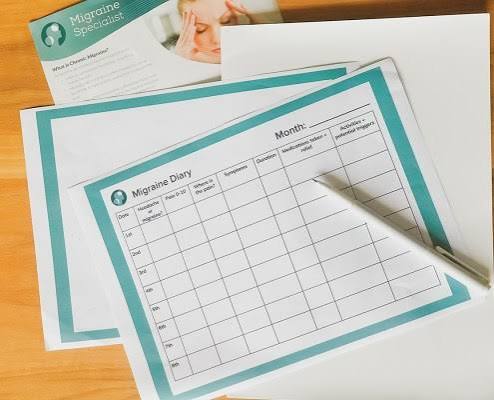
Here’s the structure I would use:
- Record the attack itself. Note start time, duration, pain location, severity, and symptoms like nausea, aura, light sensitivity, and sound sensitivity.
- Mark the 24 hours before the attack. Track sleep length, skipped meals, caffeine, alcohol, hydration, exercise, and any unusual stress or conflict.
- Log medication early and clearly. Write what you took, when you took it, and whether it helped within a reasonable time for that medicine.
- Note hormonal timing if relevant. For many people, the relationship to the menstrual cycle matters more than any single food.
- Circle repeats. After each week, look for factors that appear on multiple migraine days and are absent on ordinary days.
- Test one change at a time. When you cut caffeine, change sleep, and stop chocolate all at once, you will not know which change mattered.
I’d use a simple table in the diary itself:
| Situation | Best Path | Why Other Options Fail |
|---|---|---|
| One migraine every few weeks | Track each attack plus the 24–48 hours before it | Daily deep logging is too much and usually gets abandoned |
| Near-daily headache or migraine | Track daily basics plus attack details | Memory alone will blur patterns |
| Suspected food trigger | Log exact timing, portion, and what else was going on | “I ate something bad” is too vague to use |
| Possible hormone pattern | Mark cycle days and migraine days | Food-only tracking misses the real pattern |
| Medication not helping | Record dose, timing, and repeat doses exactly | “It didn’t work” gives your clinician no useful detail |
A lot of people ask whether they need an app. An app can help if it reminds you to log consistently. It can also distract you with charts you do not need. I would choose app over paper only if the reminder and export functions actually make your life easier. Otherwise, paper wins because it is fast.
Quick check: When your diary lets you answer “what changed in the day or two before this migraine?” in under a minute, the structure is probably right.
If You Think Food Is the Trigger, Do This Instead
When you suspect a food trigger, don’t start by deleting half your diet. That usually creates more confusion than clarity. Food triggers are real for some people, but they are also over-attributed because they are easy to blame and easy to remember.
I’d narrow food tracking like this:
– write exact foods and drinks, not categories
– record timing relative to the migraine
– note whether the food was eaten alone or with sleep loss, alcohol, stress, skipped meals, or menstruation
– watch for repeat patterns, not single episodes
A food diary works best when you stop asking “What food did I eat?” and start asking “What was unusual about the timing and context?” A migraine after a long fasting stretch plus a late, salty meal is not the same as a migraine after one random slice of cheese on a normal day.
When you want to test a food theory, I would be cautious about elimination diets. They can help, but they are easy to overdo, and they can lead you to miss bigger triggers like missed meals or poor sleep. If you try an elimination, do it in a way your clinician can review, especially if you have diabetes, a history of eating problems, or a restricted diet already.
- Pick one suspect food, not ten.
- Track it for several attacks and several non-attacks.
- Note the exact amount and timing.
- Check whether the suspected food appears only with another factor, like wine or sleep loss.
- Change one variable at a time.
If the same food shows up on migraine days and non-migraine days with no clear difference, it is probably not your main trigger.
Quick check: When you are blaming food but can’t say whether the attack followed the food by minutes, hours, or a whole day, the food theory is too loose.
When the Standard Advice Is Wrong
When your diary still shows “nothing,” the usual advice to keep recording more details may be the wrong move. Sometimes the trigger is not a single thing at all. Sometimes the pattern is a threshold: too little sleep plus stress plus skipped meals plus a busy day.
That means your diary should look for combinations.
I’d pay attention to:
– sleep debt plus caffeine changes
– dehydration plus heat or exercise
– missed meals plus long screen time
– stress letdown after a high-pressure period
– hormone timing plus disrupted sleep
– alcohol plus poor sleep
A trigger diary that only tracks one line at a time can miss the whole picture. When you’re sensitive to more than one thing, your migraines may appear when several small pushes stack up.
This is also where generic “just avoid triggers” advice falls apart. When your real trigger is a threshold, total avoidance may be impossible. The better target is lowering the number of stacked stressors. That might mean eating on schedule, protecting sleep, and planning for weather or travel days rather than cutting out every possible food.
I would also be honest about who this approach is not for. When your attacks are severe, sudden, changing, or linked to new neurological symptoms, do not try to solve them by journaling alone. Get medical care. A diary can support evaluation, but it is not a substitute for one.
Quick check: When your migraines seem tied to stressful weeks, poor sleep, or several small changes at once, you need pattern tracking, not a single-trigger hunt.
Edge Cases: When the Usual Diary Rules Break Down
When your situation looks odd, the diary needs to change with it. These are the cases where normal advice often fails.
-
You get migraine aura without much head pain
– situation → aura is the main event
– what changes → the warning phase may be the most important thing to log
– what to do instead → record aura start, duration, visual or sensory symptoms, and what you were doing in the hour before it -
Your migraines come during your period
– situation → attacks cluster around the menstrual cycle
– what changes → cycle timing may matter more than food
– what to do instead → mark cycle days, bleeding days, and hormone-related medication or contraception use -
You have near-daily head pain
– situation → too many headaches to track each one casually
– what changes → daily baseline matters as much as attack details
– what to do instead → log sleep, meds, caffeine, and pain every day; bring the diary to a clinician to sort migraine from other headache types -
You work nights or rotating shifts
– situation → sleep timing is irregular
– what changes → “hours slept” is not enough
– what to do instead → record sleep start, sleep end, and shift timing, not just total sleep -
You travel often
– situation → time zones, meals, and stress change constantly
– what changes → trigger lists become noisy
– what to do instead → track only the biggest variables: sleep, meals, hydration, alcohol, and medication timing -
You think a medication is causing headaches
– situation → frequent pain after repeated painkiller use
– what changes → medication overuse becomes a concern
– what to do instead → log every acute medicine dose and bring the pattern to a clinician; do not keep guessing on your own
Quick check: When your migraines follow a special pattern like periods, shifts, aura, travel, or near-daily pain, the standard diary template is not enough.
How to Read Your Diary Without Fooling Yourself
When you only look for dramatic clues, you will miss the real ones. The most useful pattern is often boring: the same sleep loss, the same skipped breakfast, the same stress drop, the same cycle day. I’d review the diary once a week, not every time pain hits, because single attacks can feel more meaningful than they are.
Here is how I’d review it:
– look for factors present on at least several migraine days
– compare them with migraine-free days
– check whether the factor appears before the first warning sign
– separate one-off oddities from repeated patterns
– test one change for a few weeks before changing the next thing
This is where a clinician can help. A neurologist or headache specialist can often spot whether your diary suggests migraine, tension-type headache, medication overuse, or something else. They can also help you decide whether to try prevention treatment, lifestyle changes, or both, so it is worth discussing the diary with a professional. When your headaches are new, worse, sudden, or paired with weakness, confusion, fainting, fever, or a new neurological symptom, seek medical care promptly.
A good diary does not prove a trigger beyond doubt. It points to the next most sensible experiment. That is enough.
Quick check: When your diary gives you one or two repeat suspects, you are ready to test a change instead of collecting more pages.
A Simple Workflow You Can Keep Doing
